Monday, 31 October 2016

Final long ride for a queen of the road


Jakki with Princesse and Printemps in 2012
My dear friend Jakki Cunningham died of cancer this month. She was President and founder of the SLL Sete-Lorient-London charity which I have helped and supported since they came riding across France and into my life, when the 4 horses and 3 riders including Jakki stayed overnight in June 2005. We remained friends ever since.

The SLL Charity (see website www.sllassoc.com) was set up by Jakki with the idea of buying horses in the  Camargue and using them to change the lives of young disadvantaged people as well as to help people with disabilities. In the 2008 and 2012 projects, known as Caravan of Hope, the horses were ridden and cared for by disadvantaged youngsters both French and English, who rode an amazing 1,800 kms on horseback from the Camargue in the South of France, via Brittany, then on to London. The expedition took 6 months, camping all the way. At the end of the journey, the horses were donated to centres for disabled riding or carriage driving in England and France. Contact with horses improves the physical and emotional well-being of people with disabilities, as practised by the Riding for the Disabled Association and similar groups in France.

Jakki created 4 similar projects, each one became more ambitious than the previous one, with more horses and more diverse aims. She rode or drove carriage horses on each of the projects, earning the distinction of membership of the elite Long Riders Guild, as well as handling most of the administration and correspondence. Latterly she was joined by and had the help of Fred Kermel, her right hand man and French vice president, however, the charity survived and operated through Jakki's energy and enthusiasm, with the help of a small group of loyal volunteers and trustees, and some generous sponsors and supporters.

Jakki died on 22 October 2016; she was living in the Camargue, which she had made her home since 2013.

RIP Jakki Cunningham
Sunset over l'Etang de Vaccarres
Saying goodbye...


www.sllassoc.com

Tuesday, 27 September 2016

An interesting moment

We have continued to ride out with Dan on Fina and me on Lucie, who seems to be going well and enjoying being ridden, and being my top horse again! I think she was getting very fed up of being lead from Fina.

Dan's few days away has turned into few weeks; a friend came to ride with me a couple of times and Seraphina shamelessly grabbed at everything green in her path as if I starved her, and Cécile was far too nice to stop her or anticipate it. Then Jennie came and rode one day and there was less eating allowed.  We had a nice ride although it was quite a warm afternoon, and the horses are getting their winter coats. Lucie struggled towards the end and I did a lot of walking up the hills and difficult terrain.

An interesting moment occurred with Lucie during the ride, when she stopped and put her head down to scratch a fly near her head with her back hoof at exactly the same moment that I leaned forward dropping the rope rein to swat it, and her back foot caught in the loop of the rein Luckily it was the bad leg that was caught and she was hopping on the good leg, I was riding at the time and in the seconds that pass where you are thinking, shall I get off now or wait and see how this goes, I could feel Lucie on the verge of panic; then those reflexes that are so worth teaching and hard-wiring in, to release to pressure, kicked in and she stopped fighting to free herself and stood still while I released the leg from the rope, still from the saddle. All over in seconds but could have been a nasty accident for one or both of us. Might be that this caused some extra strain or injury to her bad hock, anyway I put her back on the devil's claw.

So with Lucie grounded for a bit, I rode Fina in the paddock working on upward and downward transitions, using the corners as the stopping place (target?), and once the pattern and feel was established, she would stop as soon as I dropped my energy and strike into trot from halt or walk when I brought my life up, and I could mix it up and change where we made the transition with a similar result. Doing this also helped steady her trot and improve the tempo and maneuverability, so really pleased with it  and she seemed happy too; it's always gratifying when an improvement carries over into exterior riding and is more comfortable and connected for us both.


Thursday, 15 September 2016

Take care of the emotions

Taking care of the emotions

There have been several articles appearing recently about studies conducted on horses which amazingly conclude that they have emotions, well what a surprise, who would have thought it... Most of us who live with horses every day, and observe their actions and interactions, and strive to communicate with them and understand their behaviour, will need no such convincing.

What I continually seek is the best way to respond to a horse's emotional reactions in order to develop positive and relaxed behaviour enabling me to connect and be with my horses, and if I can influence their behaviour and have them thinking that my idea is theirs, and liking those ideas, it makes the learning fun for both of us and gives my horse  the confidence to put in the effort and offer more. A philosophy not disimilar to the models used for humans in business and leadership skills.

A couple of things have set me thinking this over recently. A demonstration by a natural horsemanship trainer in which he mentioned working with the horse's emotions. An incident with my own mare the other day. Watching videos of other training methods, including clicker training. A conversation with a friend about training methods and how a horse can turn sour.

My incident: I have started riding Lucie again, laid off from riding through lameness for 4 years. It is going well but the other day a friend asked if she could ride with me. She had a time restriction, I didn't do any groundwork prep first as I usually do, and we talked. In short, different routine, I was distracted and didn't give my full attention to the horses. Lucie spotted something out of place (I'd left a saddle cloth on the ground) and not being in harmony with me, she made a thing of it. Normally I would paid attention and I should have been there for her straight away to check it out together and take the time it takes, but I asked her to walk by. Suddenly she is irritated by a fly. She starts to jog, then she stops and shakes herself all over. At this point I realise that all is not well in her head and her emotions are up and it might be a good idea to get off! A few minutes with her quietly reestablishing the relationship on the ground and I remount and all is well in her head, the molecules have settled and we are in harmony. But I nearly let her down and she had to remind me, that trust is mutual, that she needs me to be a strong leader and pay attention to the things she thinks are important.

The old-fashioned idea is to never get off, that is somehow giving in, where do these ideas come from and why are they perpetuated?

I got off because I believe that the relationship is established on the ground first, and this connection and understanding continues anywhere around, near or on the horse. I should have checked it was there before I mounted, and I should have checked in with my horse instead of talking to the friend, at least until I was sure the horse was happy and confident in herself to be left on autopilot.

The trainer I mentioned described his training method as being as much about working with the emotional state of the horse as anything else, and I like that vision.

I am not going to say that my horses or those of others practising pressure and release or comfort and discomfort as part of their training, are never stressed. Or that I and every trainer like me are always correct in assessing the stress levels in the horse in front of them. However, part of the attraction for me of NH methods and in particular Parelli NH, is the acknowledgement that stress happens, the understanding that a stressed horse is not in a learning frame of mind, the observation of horse behaviour and changes, and strategies for dealing with the horse that shows up, how to encourage and reward relaxation and work with rather than against the horse's nature. I cannot agree that NH methods may suit one horse and not another, however there is not one strategy to suit all horses, and advanced skill and experience teaches you to be adaptive and improve your timing, know when to ask for more or do less.

So should we try not to put too much pressure on our horses, never let them get stressed?

To progress, we have to test, ourselves and the horse, sometimes push the boundaries to find out where they are. I see a difference between pushing a horse over its threshhold and forcing it to do something it is clearly having difficulty with, to asking the horse to confront its fear, sceptiscism or resistance, and give something a go. Because he trusts you, and respects your ask. It's playing with the boundaries, finding where they are, letting the horse know there is a safe place to return to, not pushing too hard or too far. Timing and phases and focus, being a strong, calm base for your horse so he can face his emotions and maybe offer a little more than he thought he could. But if you don't ask you will never know what you can do.

Most of us seek to do the best for our horses, whether we term that to be care and love, or respect and responsiveness. To deny that our horses have emotions is to deny them their right to express themselves. Human beings have fought against suppression throughout their history. I prefer not to be an autocratic dictator to my horses, I love to try to read their emotions and to do my best to help them be in harmony with me and themselves. I know when I have got it right in their eyes by the way they come enthusiastically and chose to stay around me.

Reading horses is a complex and unscientific pastime, there can be no proven way to say one thing not another. However there is enough science and proof of signs of stress or relaxation that with a little bit of study, a lot of desire and patience and hours of observation, everyone can take care of their horses emotions. To do so is surely a question of mutual respect and complicity and not putting human goals and values first.

The desire to master a training method or discipline can sometimes blind us to what the horse thinks about it and to overlook or misread the signs.

One question I would like to ask of clicker trainers of horses is, do you think you are taking care of the emotions? Because everything I have seen of CT with horses appears to me to produce stress and not much sign of it being recognised or dealt with in a CT session.

And yet CTers are among the strongest criticisers of NH methods claiming that pressure and release causes stress.

Evidently we are not seeing the same things or someone is in denial.

Clicker training for horses leaves me asking why? I do not believe it is not stressful for horses, or that it is kinder than natural horsemanship methods generally. I have yet to see a demo of clicker training in which the horse wasn't exhibiting some stressful reactions. It may be appropriate with other species but the horse is a herd animal which has survived and adapted for centuries, with a very specific social hierachy. I fail to see why with all the alternatives old and new, this is thought to be appropriate for horses. I can accept that it can serve as a short cut to getting a horse to accept and even enjoy a necessary event like handling feet or in a case of injury. But as a stand-alone or everyday training method it appears totally uneccessary and very distracting and unsettling to introduce clicks and treats. I simply do not see what use or advantage for horse or human.

Thursday, 4 August 2016

Summer visitors and hacks

In August, former owners Helen and Ali came to see Fina, and Jennie came over too. It wasn't too hot so we had a play with the ponies after lunch. Nice to see Ali and Fina together again.  Ali rode and even jumped Fina, and in the end everyone had a ride on her, and I sat on Lucie bareback. Helen took these super photos. Super relaxed afternoon chatting and playing with the horses.


It has been hot and I am not good at getting my act together to go out early in the morning. On a cooler day we went for a short hack, with Dan on Fina, me on Lucie. Dan is enjoying riding out in the woods, even managed to take the saddle off himself and brush her a bit yay!!


Thinking of what I had seen with Pat and Vision, I tried to have no grey areas with Lucie, be uncompromising, not accept a half effort from her, and I noticed a better expression as a result.

I do feel that I am finally getting reasonably competent with this method, it may have taken long enough but I can now be confident and assertive when I ask, on the ground at least, and the responses from the horses tell me I am doing okay.

Sunday, 31 July 2016

Masterclass with Pat Parelli

I went over to the UK for the Pat Parelli Masterclass "Beyond the Basics", in July 2016.  I was a gallery spectator and Pat was teaching 12 students, and everyone got to ask questions, there were about 150 spectators and he was teaching right in from of the gallery. Beautiful arena at Oakridge Quarter Horses in Collingham near Newark. In fact I might not have gone but being just up the road from my brother's house, they bought me the ticket as a birthday present and Istayed with them. I might not have chosen to spend money to see PP himself as there are some great instructors out there who I would like to spectate, but it all fell into place and I have enjoyed it, great atmosphere, a fab 3 days watching and learning and ideas to bring home and practise. There were lots of old jokes but also much humour and help in the teaching and presentation, and some new thoughts.

There were several recurring topics such as push not pull, influence the horse, using positive energy, reins are for shaping, balancing the aids, etc. Also we were told to forget some previous ideas and techniques and move on. More than once, Pat told the students, "I know I taught you to do that, now I'm saying do it differently".

One of the first challenges or groundwork exercises was moving the horse back and sideways without touching the rope or using disengagement as, he said, I taught you to use that, now I'm telling you to forget it, or use it less, only if necessary, because it breaks the connection. This made the participants work really hard!

The level of skill wasn't that high, I mean, I had expected to be watching higher level students and they were my level or lower on the whole, a mix of ages, some quite young, and two ladies looked my age or more and some of the riding quite inexperienced, even allowing for the situation and nerves, I saw a lot of reliance on reins and that dreadful constant thoughtless heels nagging, which was greatly improved by the end and as a result of the teaching. There were some pretty horses, I liked the little appaloosa, and the grey arab type looked good under saddle, and there were 2 handsome dappled greys, and a very nice palomino QH.

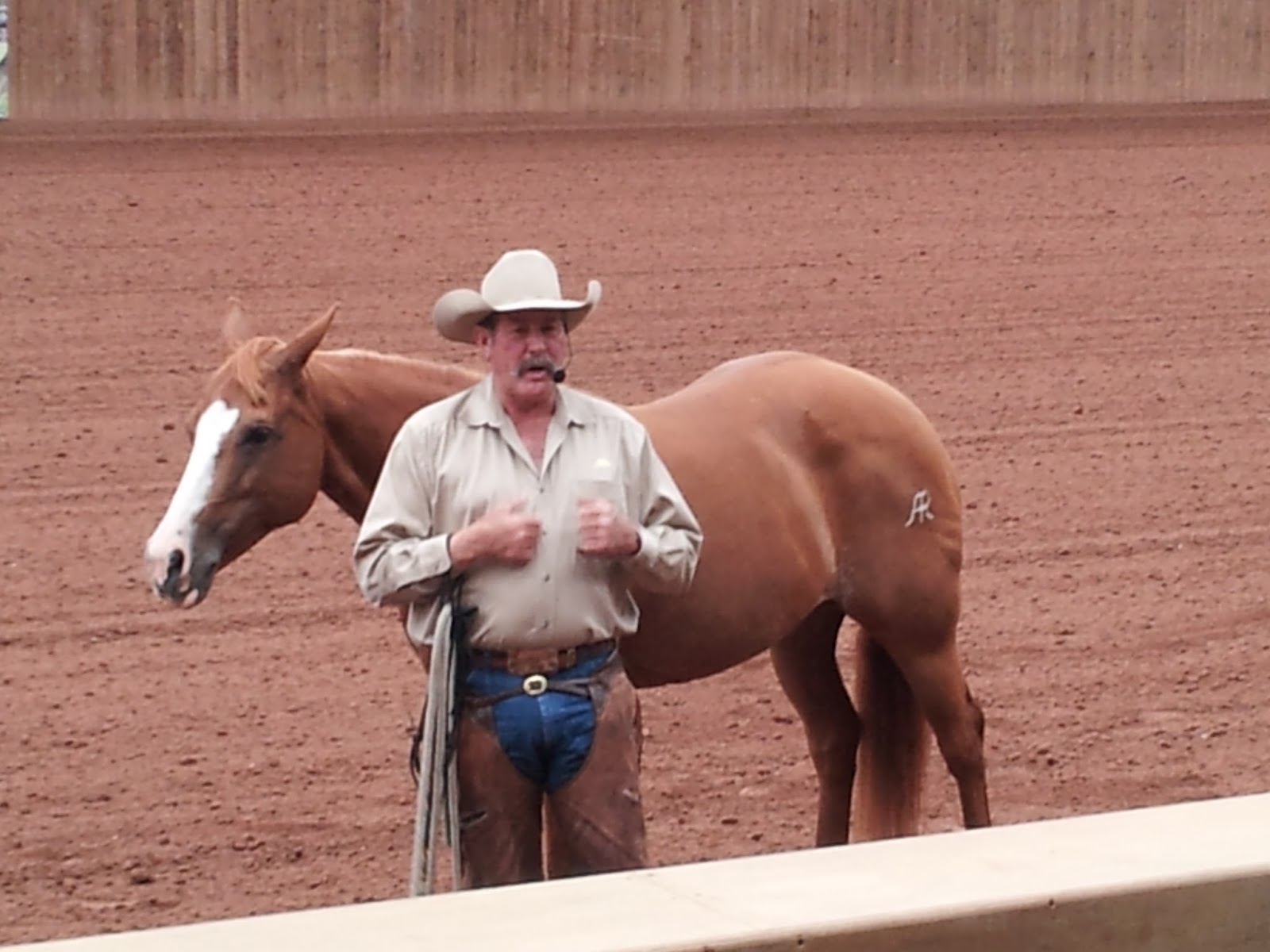
Pat with his mare Vision during the first afternoon introductory seminar.


He got a bit boring as I have heard it all before and the old jokes, but he is a bloke, and American... So I had plenty of time to observe Vision and was fascinated by her apparent fascination with him, she was relaxed and had soft body language but was totally tuned to his every movement and mirrored him, if he walked off she walked at his side, stopped when he stopped, as you would expect, but if he asked her something, to demo a point, she responded. For me watching, and he was right in front of the gallery, I could barely spot the change in body language but Vision did. I also observed during the 3 days, and when riding her,that Pat was uncompromising with her, if he askedher to move and she didn't respond with effort, he appeared to reinforce quite strongly, but she showed no sign of offence, so presumably she took it as firm but fair. Hmm, how interesting... I have mares and as some of you know, Lucie and I have had our moments and misunderstandings and she taught me how important leadership is to a mare of this type, no grey areas, they have to believe you are up to doing a better job of leadership than them, if not, they argue. Lucie still argues if I ask her to do something she doesn't think important or isn't in our general routine, although she will stick to me and respond appropriately with that lovely soft look on the everyday moving around etc. Food for thought.

These photos were taken first day first hour, the students had 15' to warm up before Pat came in and I expect they had been able to play with their horses in the arena beforehand, there was no whinnying, no horses trying to sniff each other or be with other horses, none of the usual fuss, shouting and mayhem that you so often see at shows or equestrian events, all was calm and concentration, each couple in their own space as a herd of two. As spectators it was interesting to read the horses' expressions and guess which partnership had a strong connection or which would break and have to be re-established or strengthened, and whether this occurred at different distances or certain movements or change of pace.


I wrote up about the Masterclass on a forum (A Matter of Horse) and was asked about the teaching level and approach, this was my explanation:
These 12 students were new to him but they were not new to the method and had to be a certain level to participate. So they would have all started with the 7 games on line and progressed to maintaining the connection at greater distances then test the connection at liberty and riding. Each of these horse human partnerships entered the arena either on a loose long rope or at liberty. The tasks that Pat set would test this and provoke questioning and thinking, and techniques to strengthen the connection. So he works on a "can you" as in can you ask your horse to go sideways away from you down the centre of the arena, can you ask your horse to circle round you at liberty at trot, can you send your horse around two cones in a figure 8 at liberty, etc. Then, how can you improve that, how can you get your horse to do that with more effort, or at canter, or with a better look on its face, etc. Always pushing the boundaries, if it breaks down, ask yourself why, which element is broken (isolate, separate and recombine).

Sunday, 17 July 2016

Riding Lucie again,at last!

First proper hack for Lucie since she went lame! Dan rode Fina and I rode Lucie!. We did about 4 km and I got off a couple of times, but she seemed fine; she walked out strongly and wanted to be in front and didn't ask to stop or rest and Dan said she looked okay from behind so it is very promising,and such a thrill to be on her again, after nearly 5 years lameness, and the possibility of her being a field ornament for the rest of her life.

She feels very narrow after Seraphina!


Tuesday, 7 June 2016

Private lessons Part 3 Freestyle

First I had some fun with the one rein riding, and the carrot stick riding too; both helpful for thinking and developing focus and direction through feel, and not relying on the reins. Interestingly I find it hard not to use a tool when it is in my hands, be it rope or reins or stick, and spend time teaching myself not to pick up tool or rein unless I am asking something. A very human habit I'm afraid! These exercises really helped.

The audience watches us check our neutral lateral flexions and Dave takes photos
 
Jo is coaching me how to throw the rope over her head as I sort myself out for one rein riding

Carrot stick riding was really good and helpful


The carrot stick was held in the inside hand, resting the end on the pommel and the tip on my shoulder. Going round the small arena, I try to turn at the corners and follow the rail/sides as close as possible; of course, the horse doesn't understand why I want to do this and is likely to take her own course, or cut corners, which is logical for them to take the shortest route. The aim for me is to look and focus where I want to go, adjusting hip and belly in that direction, which means a weight shift cue to the horse; then if she doesn't respond I can slowly bring the end of the stick in an arc from my shoulder to point towards her nose to redirect it, using a gntle rolling motion. It is not meant agressively or to touch the horse but just suggest she move her nose over and the body follows. It certainly helped Fina understand what I wanted without having to use a hand or leg aid. Then we introduced points at which I would turn her 180° in a similar manner. In "normal" riding in this same area, I was constantly putting her back on the rail with rein or leg, which was becoming frustrating for both of us. Of course there are other ways you might do this but I found it helpful and works for us. I think this use of a stick when riding is a Parelli technique, not sure if others do it. We didn't have time to develop all these ideas further, Jo was giving me techniques to play with and hopefully develop later on my own. The aim is not to use the stick, it stays in the neutral position on my shoulder, it is only there for support if the horse doesn't respond to the ever reducing cues. After a few minutes of this, we were able to negotiate the weave through the line of tyres without the need for me to do more than look where I wanted to go and Fina picked up on that slight feel.

Other patterns for developing focus and carrot stick riding, after starting with follow the rail:
Corners
Point to point
180 turns
Transitions
Circles
Figure 8
Weave
Question box
Clover leaf

We also looked for a soft feel and some framing or shaping, through step 7 of the 9 step back up, preparing the horse for forward movement.