Tuesday, 7 June 2016

Private lessons Part 3 Freestyle

First I had some fun with the one rein riding, and the carrot stick riding too; both helpful for thinking and developing focus and direction through feel, and not relying on the reins. Interestingly I find it hard not to use a tool when it is in my hands, be it rope or reins or stick, and spend time teaching myself not to pick up tool or rein unless I am asking something. A very human habit I'm afraid! These exercises really helped.

The audience watches us check our neutral lateral flexions and Dave takes photos
 
Jo is coaching me how to throw the rope over her head as I sort myself out for one rein riding

Carrot stick riding was really good and helpful


The carrot stick was held in the inside hand, resting the end on the pommel and the tip on my shoulder. Going round the small arena, I try to turn at the corners and follow the rail/sides as close as possible; of course, the horse doesn't understand why I want to do this and is likely to take her own course, or cut corners, which is logical for them to take the shortest route. The aim for me is to look and focus where I want to go, adjusting hip and belly in that direction, which means a weight shift cue to the horse; then if she doesn't respond I can slowly bring the end of the stick in an arc from my shoulder to point towards her nose to redirect it, using a gntle rolling motion. It is not meant agressively or to touch the horse but just suggest she move her nose over and the body follows. It certainly helped Fina understand what I wanted without having to use a hand or leg aid. Then we introduced points at which I would turn her 180° in a similar manner. In "normal" riding in this same area, I was constantly putting her back on the rail with rein or leg, which was becoming frustrating for both of us. Of course there are other ways you might do this but I found it helpful and works for us. I think this use of a stick when riding is a Parelli technique, not sure if others do it. We didn't have time to develop all these ideas further, Jo was giving me techniques to play with and hopefully develop later on my own. The aim is not to use the stick, it stays in the neutral position on my shoulder, it is only there for support if the horse doesn't respond to the ever reducing cues. After a few minutes of this, we were able to negotiate the weave through the line of tyres without the need for me to do more than look where I wanted to go and Fina picked up on that slight feel.

Other patterns for developing focus and carrot stick riding, after starting with follow the rail:
Corners
Point to point
180 turns
Transitions
Circles
Figure 8
Weave
Question box
Clover leaf

We also looked for a soft feel and some framing or shaping, through step 7 of the 9 step back up, preparing the horse for forward movement.

Monday, 6 June 2016

Private lessons with Jo Bates Parelli 2* instructor Part 2 - Liberty

Fun at liberty


In Parelli, we don't practise "join up" and do not chase the horse around. Sometimes we might ask the horse to move its feet or encourage it to keep moving. If the horse loses concentration and connection, a technique is to ask for the hindquarter yield to bring the head round and this usually helps the horse to reconnect, the move can be repeated but will be replaced by more subtle signals as we progress in our understanding and confidence together. The stick and string can be a useful tool as a prolongation of the body and give us body length, and clarity in signals. 

Using the round pen gives us a safe area and an advantage, it's easy to "catch" the horse and reconnect if he leaves.

Preparation is playing on the 22' line at the end of it, and "stick to me" alongside the horse on a slack line. Liberty is the test of connection and progress. Test and challenge by playing sideways at the end of the rope, or weave fromthe fence. Notice if it comes unstuck, and at what point.

Ask yourself, how can I communicate more clearly? How long does it take to establish a good connection? How can I cause her to stay connected?

Once the halter comes off, there is only the truth...


Jo shows me how to slip the halter by undoing the knot and holding both ends, then disengage the hindquarters and walk off, as if going somewhere... the horse follows closely, and the crowd goes wild...

At liberty, in the round pen, developing draw - one of our first topics, was very relevant and here in this photo I have Fina coming towards me happily as I go backwards; I like the French word for it : aspiration

And again, as she comes in off the circle:

Once or twice it was too much for Fina, and she left me, taking herself to the perimeter of the round pen in trot or canter; Jo reminded me to act as if the rope was still there, to disengage to turn her in and come back to me.


Tests and challenges: will she walk when I walk, stop when I stop. If she goes past me I can use the stick in front to back her up a step. The sweet spot is now the side of the neck.

Stick to me in figure 8.

Sideways.


Yoyo, how far can I drive her. Be accurate, don't drive one eye, make sure energy is centred and the stick position too.

Use the centre, with me, as a sweet spot, a desirable place to be.


Don't let her leave, but if she does, treat it like a circle game. Don't let her decide when to stop or turn in; gentle but firm resend, thanks for asking but not yet... 

Experiment to find out what causes her to leave - pressure, distance, etc.

What motivates her to stay

Invisible string, use hand as if the rope is still there.

Get playful, provocative, use the "ping", don't be afraid to bring her emotions up.

This stuff is soooo much fun....


Saturday, 4 June 2016

Private lessons with Jo Bates Parelli 2* instructor Part 1 - Online

June 2016, and a brilliant two days of private lessons, at home with Seraphina, with Parelli 2* instructor Jo Bates.
 
Private lessons are addictive!

Clinics and workshops are great, but you learn so much more in one-to-one teaching, and working with my own horse too. I had been worried that Fina would not be able to deal with the concentrated attention, but she appeared fine and "with us" throughout, except for one small period of introversion in the first hour which we waited out. There was lots of talking in between tasks, and we gave her time to digest her thoughts before moving on. I think Fina enjoyed having my undivided attention and was very connected, she loves learning as long as she isn't rushed, and when we were talking or giving her a rest, she chilled with us and didn't try to go off and eat as they do when they are bored or unwilling to participate. The sessions were not long, and broken up with discussion and theory, and lunch, and so we did online in the morning followed by a liberty session, to test the connection once the halter was off. After lunch was recap, pre-flight checks then freestyle (riding without contact), in the halter, and using the carrot stick for turning which is something I haven't done alone as I wasn't really sure how it worked. I found it really helped Fina and enabled us to "follow the rail" and use some other patterns designed to develop sense of direction and riding with feel, without using the reins, leading to bridleless riding, which is one of my goals.

My brief to Jo was to look at online and freestyle (riding without contact) and some liberty. So the mornings were spent on line, finishing with a short session in the roundpen at liberty, to test our connection; and saddle up for freestyle in the afternoon. Two days of teaching meant I could learn one day and progress and refine the next. As always, Jo's teaching is structured but flexible, and inspiring as well as fun - totally addictive!

Online

First Jo wanted to see us in all 7 games to assess us. A few things showed up including something I wanted to ask about. I could send Fina, or back her up, but asking her towards me, I didn't have a good draw and I was relying on the rope. Jo coached me with suggestions and some patterns to help; (see below) and very quickly I had Fina moving happily towards me. Then we were able to use this on a circle then figure 8.

#1 extreme friendly game

#2 vertical flexion from the halter. Wait, don't increase the pressure, wait for them to find the release.

#3 quality, lifting of shoulders, do it until have quality and rhythm and effort

#4 : Improving draw. Isolate, take that ingredient. What creates draw? Start close, one or two steps. Invite with body, suggestion on rope, stick at side. Support with stick to side, invite with body back and open, don't rely on porcupine but slight feel on line. Patterns to improve draw. Semi circle then back along fence, keep facing them then draw backwards. Sweet spot in centre of head, face because you want the two eyes, two ears on you. Increase distance gradually. A pattern to help. Off circle using fence or rail to support. Send as for circle, then move towards fence and as horse reaches rail, backwards and draw. Remember to keep belly button towards horse, don't turn sideways. On circle, change of direction, with draw backwards. Then step forward towards horse support with stick to shoulder, could you please, take that bit away. No spiralling, keep body straight.


Some notes from the lessons and thoughts for the day (to remember!):

Testing the 7 games and knowing why we play online : Teaching. Preparation for riding and for liberty. For safety. For fun.

Remember it's about winning the games, not just playing them.

Motivation, have a goal, a reason for doing something.

Use filter of quality, distance, speed. Think about testing through these, in that order, and look for where they meet the edge, you can push the horse to it and bring back, thus expanding and playing with their limits.

They need to own the solution. Waiting and allowing them to rest on the release and think helps them to do this. Allow them to relax between requests.

Circle and squeeze games - be playful, provocative

Don't let them tell you but don't make them feel wrong.

Do they need consistency or variety?

Mind, flexion, weight, feet : Look for the mind going and do something when it's just a thought - watch for the ear or head turning away, do less sooner than more later - don't let them leave!


Thursday, 19 May 2016

A horsey weekend


I have so many photos from the lovely horsey weekend spent with Jennie, Susan and Laura, and our horses; it is taking me ages to choose the ones to share from so many super (and embarrassing) images and videos, thanks to the lovely Laura who so kindly watched most of it through a lens!

Lucie: with reliable helpers here to observe and give feedback, I decided it was the moment to put my weight on Lucie's back and see her reactions. We started by me standing on a log and leaning over her back and when we were both relaxed about it, I slid my leg over. Quite a moment to be up there after 5 years - it was in autumn 2010 that her bone spavin was diagnosed. As all seemed well and she hadn't so far collapsed under me, we walked her a few straight steps, and she seemed to move easily enough. 

On Sunday, I put my old Etonian saddle on her, and got on. She felt very narrow after the chunky Fjord but she walked around without signs of weakness on the bad leg or lameness or feeling of discomfort or resistance. When I got off, she gave a little nicker, an enduring thing she always used to do, as if to recognise me back beside her.


Seraphina: we started out with the groundwork to see how connected we were; Susan asked to see what we had been doing together and when Seraphina didn't show much enthusiasm with the obstacles and groundwork on line, she suggested we tried some free work; not being very sure Fina would stay with me, I unclipped the rope; as it turned out, I should have taken the halter off as she stuck to me from the first and off we went down the paddock, turned at the far end and trotted up the long side, she stopped dead when I stopped, backed up, trotted off in step with me; then she weaved in and out the tyres at trot as I ran along beside her, just motioning with my hand to go around the outside of the alternate ones; I changed sides and same again, then we did it backwards with me alongside, then leading by the tail, backwards weave round the tyres; turning and changing direction, yields and turns, she was totally into it and connected, stuck to me like glue, it was thrilling and better than I hoped for, I just went with it and asked for all the moves we know and then a little more, or rather, asking less, getting more - I must learn to trust her more and see what happens in future. Once or twice at the beginning she lost confidence or concentration and trotted off to where Lucie and the others were watching, by the entrance and shed, but as soon as I went to her she reconnected and off we went again. 
Stick-to-me
Back-up


Weave

Lead backwards by tail


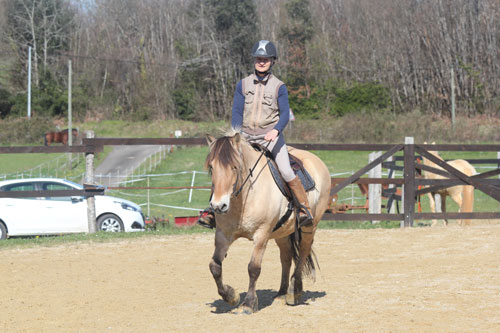
In the afternoon, and again on Sunday morning, I rode Fina. I wanted to check she was happy in the bit and get an informed opinion and continue with the ridden work from the dressage clinic as well as some of the points that came out of the ridden session with Bandit the previous day. Different horses but both needing to soften to the bit and lift and carry themselves better. The same problems that I experienced before manifested themselves, needing to slow down Fina's trot and not allow myself to be pulled forward with it, to have a loose rein and control the trot and direct her through my body, and with Susan's excellent feedback and suggestions and reminders it was looking a lot better and she left me with the challenge to get as much lightness and feel with the bit as we have in the halter. My own thoughts from this are that I would like to achieve this in a sidepull or bitless bridle, but we didn't get on to that this time. We did get lots of nice softening from Fina but I still have a tendancy to lose my shoulders and core which is not helping her.


What was interesting was being able to see from the ground with Laura riding Fina, this helped me to understand what was happening, and Laura's photos and videos are a huge help with this too. Of course, I am not showing the bad moments here!
Laura on Fina
A few more:


Warming up on the circle

Change of direction

Thursday, 21 April 2016

Dressage clinic with Denise O'Reilly April 2016

We finally got to do the postponed dressage clinic the first week in April. Having lessons over 3 consecutive days was great, only maybe I could have done with a couple more! The first issue to sort out was Fina's fast trot, she sets off like a runaway train, which was taking me out of position and my timing was poor on correcting her and releasing when she steadied so that had to be addressed before we could move on. We did however get complimented on improving her lateral suppleness. I needed to (continue to) work on my core which still tends to collapse. I was put in a body belt to help remind me (like being back in pony club when you had a crop stuck down your shirt or behind elbows!) but we were getting a much steadier trot and flashes of some nice work, and good results from the various exercises. We stayed in trot work and didn't get on to any canter work or advanced movements but made real progress in the areas I felt I needed help on, like the trot speed and tempo, and my position and the effect on Fina's way of going, and our communication. On day 3 we managed some nice soft thoughtful trot work with flashes of how Fina will feel like if I keep this up; she has a really exciting powerful trot when steady and engaged, and when it all came together for a few strides, it made me smile as I remembered how it should feel like (from a time when I rode better and on "proper" horses). We can't do the next clinic, which is in June, but maybe the autumn one, if my purse allows. The good news is that the steady, thinking trot is still with us, even when hacking Now I really must get a bit of flat field fenced off.


Before...

... After

Tuesday, 1 March 2016

Everything means something

Everything means something in the horse's view of life


The little details matter


It's important to your horse in their view of the world that you pay attention to little details, because if you don't notice them be sure that the horse will. Be aware of their Attitude. Like how they go past you when asked, or how they lead, are they pushing just a little into your space maybe with their shoulder? Who is really leading who? Are they giving you the respect they would another higher ranking horse? Do they stop when you stop, or do they take an extra step? It's easy to let it go, say to yourself they were not paying attention. You may think it doesn't matter. That's where you would be wrong, you are most likely losing a tiny bit of respect in your horse's eyes; and those little things can add up, until one day you may notice that your horse has started making faces at you, or moving into you, and it isn't an accident, it never is with horses!

Ignoring the signs, the little details, is also losing a big opportunity to create, nurture and maintain that respect, and to have the rapport and partnership that the best horseman have. Not through fear, not through mastering and manhandling, or micromanaging, but through mutual politeness and respect. That is how it works in horse world. Because if the horse believes you merit respect he will do anything for you. It really is that simple. It may look wonderful and magic how the spectacular equestrian trainers like Lorenzo or Jean-François Pignon can perform with multiple horses but it all starts and rests on this.

So these are the little things that you can correct without giving offence to your horse and that make a bigger difference than you might imagine.

If like me, you check the groundwork every day, and before riding, test the responses, ask for a forehand and hindquarter yield on both sides, note any difference or blocking, maybe ask again for a little more effort or less resistance. But it should start before that, the moment you approach the field. The way in which you approach the horses. How you halter them. Before even talking about how you ask them through the gate. You get the point.

Like looking through the wrong end of a telescope.

Take any of these as an example:

Going through the gate.
Who goes first? You do, you're the leader. I teach my horse to wait while I open the gate, then I pick up the lead rope and invite her to follow. I may stop to adjust the gate, if she doesn't stop I ask her to.

Look out for that extra step.
When walking or leading your horse, does he take an extra step when you stop? Do you correct this, always, sometimes or never, or don't need to because he doesn't do it? Or maybe you haven't noticed.

Start to notice, because your horse will, and it means something to him. One day it starts with a little step, barely noticeable; next day it might be two steps; then one day there will be a big bang and if you wonder why, start thinking about the little signs you may have missed, before you blame the scary corner or the flapping plastic.

Everything means something to the horse, to some more than others but only in what they do with the knowledge. So allowing your horse to make decisions may be useful in some situations, but in others it just tells your horse that you are not an effective leader, and that belief or perception of you can lead to their lack of confidence in other situations.

So next time you lead, notice if your horse takes the extra step. If so, ask him to take that one step back. Quietly, not as if it's a big deal. And do this every time you stop and he doesn't, and do it occasionally at any time, to reinforce the principle, that you are the leader and you decide when he moves his feet and who goes through the gate first.

Of course, you will be doing this, as you do everything, quietly and without emotion, assertive not aggressive, and in my view without complicating it with vocals or treating. This is a basic respect issue.

So observe and don't ignore or underestimate those little signs; take care of th edetails and the big picture may take care of itself.

A small step for you, a big step for your relationship, and maybe your safety.

Monday, 29 February 2016

Safe haven or scary place


Not a very nice week weather wise, or at least, not on the days when I was able to get the horses out. We have a new car so it got the garage space where I used to shelter and tack up the horses so I'm having to change my habits and prepare them near the woodsheds and field shelter. I had just got them ready for a hack on Thursday hoping to dodge the rain, when it poured down. So we headed for the field shelter. Not Lucie's favourite place at the best of times - she will use it in summer, for shade, and allows Fina to stand in it with her to keep the flies off her face. On a wet and windy day, Lucie  would rather stand out in the rain; well, not even stand because there are scary noises out there which need keeping and eye on. So while Fina, who I think was delighted to find she could stand in the shed unchallenged, and I sheltered from the rain, Lucie fidgeted about on the end of the rope and got wet. I treated it as an exercise, allowed her to move her feet when she needed to, not trying to make her stand still or come inside until she offered to, then allowing her to float out again when she felt insecure; she did accept to stand with us for a while.

Once the rain stopped, we had a quite a nice ride and lead, both horses happy to get out and get moving. Later we came to a fallen tree which I had to get off to move; the horses waited patiently but once again Lucie's horsenality got the better of her, she thought I was taking too long and it would be quicker if she did the job herself and only managed to get entangled in the branches... 
 I took this photo when I got off to move the fallen branch, and before Lucie got bored of me taking photos and broke ranks...

Just a couple of examples highlighting the different horseanalities of my two mares, and how for Seraphina, standing still is a comfort, while for Lucie it is often a trial and brings on anxiety and the need to move her feet. Being in an enclosed space is hard for her.